

Can companies still conduct effective supply chain due diligence in China?
Written by James Lewry
SUMMARY: China’s August 2026 countermeasures disrupted parts of the assurance infrastructure used by global companies, but they did not remove companies’ responsibility to conduct due diligence. The immediate challenge is operating in an uncertain, evolving environment. Companies need to understand where their programmes depend on affected organisations, make targeted and clearly explained requests to suppliers, and develop credible alternatives for collecting and verifying evidence.
Last month, a Tier 1 battery supplier in China stopped responding to our client’s request for information needed to support compliance with the EU Batteries Regulation. At first, the company thought that the supplier’s silence was a refusal to cooperate. In fact, the supplier wasn’t sure about the request’s scope. They were concerned about sharing information beyond direct operations and were unclear about how the information would be transmitted and used outside China. Once our client explained which products and minerals were in scope, why the information was needed, who would see it, and how it would be handled, the supplier provided the necessary information.
The case illustrates the practical challenge companies now face. Due diligence remains possible, but requests that appear routine to an international buyer may carry legal, commercial or political sensitivities for a Chinese supplier. Effective engagement increasingly depends on precision, explanation and trust.
The August heat
When China’s Ministry of Commerce put six US organisations on its countermeasure list on 5 August 2026, including the Responsible Business Alliance (RBA) and Verité, many companies asked whether supply chain due diligence in China was still possible. In our August article, we argued that many programmes had come to lean too heavily on certifications, shared audits and third-party technology. Two months on, there is still a lot of uncertainty but the answer is starting to get clearer. Due diligence in China is still possible. What has gone, or at least been disrupted, is the option of leaving most of it to someone else.
That matters because the obligation never sat with the scheme. Under the UN Guiding Principles and the OECD Guidelines, and increasingly under law, companies must identify, prioritise, and address the risks linked to their operations and supply chains. Schemes, shared audits and platforms are useful inputs to that work, but they were never a substitute for it. Nor does effective due diligence require treating every supplier, facility or risk equally. International due diligence frameworks, and increasingly regulation, are built around risk-based prioritisation: companies are expected to focus attention where adverse impacts are most severe or likely, and to deepen their assessment where the risk warrants it.
Targeted review is therefore not a retreat from compliance in response to the challenges in China. Done properly, it is consistent with how effective due diligence is supposed to work. A risk-based approach has always been the stronger model; in China, it is now the only workable one.

What has changed?
The legal groundwork was laid in spring, well before the summer listings. Two State Council regulations took effect within a week of each other: Decree 834 on industrial and supply chain security on 31 March 2026, and Decree 835 on countering foreign “improper extraterritorial jurisdiction” on 7 April. Article 13 of Decree 834 prohibits supply chain investigations and information-gathering in China that breach Chinese laws and regulations. Decree 835 allows the authorities to designate a foreign measure as improper and order a specific party to stop implementing it. The Ministry of Justice made its first determination under it in May, and the Ministry of Commerce (MOFCOM) issued implementing measures for Decree 834 investigations on 22 June.
But the important point to remember is that neither regulation bans questionnaires, audits, supplier visits or due diligence. Many of their key terms remain undefined, and that ambiguity, more than any explicit prohibition, is what has made Chinese suppliers cautious.
The real disruption came on 5 August, when MOFCOM used the Anti-Foreign Sanctions Law to add six US organisations to its countermeasure list: the RBA, Verité, Altana Technologies, Applied DNA Sciences, Stratum Reservoir and Human Rights in China. MOFCOM said this group had assisted and supported US Xinjiang-related sanctions. Organisations and individuals in China may no longer transact or cooperate with them. The listing came five days after the US added 43 China-based companies to the Uyghur Forced Labor Prevention Act (UFLPA) Entity List, although MOFCOM has not formally linked the two.
The practical scope of the measures is narrower than some initial headlines suggested, but it is still evolving. The restrictions apply within China, while the RBA has said its activities elsewhere are unaffected. Organisations and individuals in China are prohibited from transacting or cooperating with the listed entities, and Chinese industry guidance has instructed companies to stop activities including RBA and RMI audits, training, fee payments and data submissions. However, the authorities have not issued comprehensive guidance explaining how every form of RBA-related interaction will be treated. Companies should therefore avoid assuming that all possible boundaries are settled and plan on the basis that Chinese suppliers and subsidiaries may take a cautious view.
What we know so far
| Date | What happened | Implications for companies |
| 5 August | China’s Ministry of Commerce lists six US organisations, including the RBA and Verité, with immediate effect. A spokesperson described the measures as restrained and warns that more will follow if the US adds new restrictions. | Treat further listings as a real possibility when you plan. |
| 6 August | The China Chamber of Commerce of Metals, Minerals and Chemicals Importers and Exporters (CCCMC) tells Chinese minerals companies to stop RBA and RMI audits, training, fee payments and data submissions at once, to be careful with existing audit results and logos, and to look for alternatives. | RMI activities involving organisations in China are directly affected because the RMI is an initiative of the RBA. Companies should not expect Chinese suppliers or facilities to participate in RMI audits, make payments or submit information to the RMI while the restrictions remain in place. |
| 14 August | The RBA makes its first public statement. It says it is complying, that the measures apply inside China and that its work elsewhere is unaffected. | You can stay an RBA member outside China, unless you are a Chinese-owned company. Anything that needs a party in China to deal with the RBA is not possible. |
| Mid-August | RMI paused new RMAP assessments in China and extended the validity of existing RMAP conformance determinations for affected Chinese smelters and refiners until further notice. | A facility may remain on the RMAP conformant facilities list even though the assessment supporting its status is older than would normally be expected. Companies should record both the facility’s current status and the date and scope of the underlying assessment. |
| Late August | Law firms publish their readings. The common ground: the ban also binds the Chinese subsidiaries of foreign groups, there is no asset freeze or entry ban, and using RBA-branded questionnaires or templates in China without the RBA’s involvement is a grey area. | Check your contracts. A Chinese supplier can no longer meet a clause that requires RBA or RMI conformance. |
| Early September | A month on, the Ministry has still not published guidance on what counts as a prohibited transaction or cooperation. RMI’s reporting templates remain available, including unbranded versions. | Until there is guidance, suppliers and their trade bodies will err on the side of caution. Don’t wait for clarity before you adapt. |
| Since August | Attention has also turned to Chinese alternatives. CCCMC has issued responsible minerals due diligence guidance, while associated Chinese assurance standards and mechanisms are gaining greater attention internationally. | Assess each instrument separately, including its governance, assurance model, independence, coverage and acceptance by relevant regulators or markets. |
Developments as of early October 2026.
Post August 2026, two things are worth noting. First, there has been no official guidance or indication of a way back for the RBA in China, so plan for the uncertainty itself. Second, a Chinese smelter’s place on a public RMAP conformity list now tells you less than it did because an extended RMAP conformance status provides less current evidence than a recently completed assessment. Therefore, companies should consider the date and scope of the underlying assessment alongside the listed status.
The cracks were there before August
The most significant thing about August, however, was not the listing. It was what the listing exposed: how much of companies’ China due diligence relied on infrastructure they did not control. The warning signs had been there for some years. Several audit bodies stopped working in Xinjiang from 2020 because credible audits were no longer possible there. The 2023 raids on due diligence and consulting firms, and the broader Counter-Espionage Law that took effect that July, made independent fieldwork in China harder and riskier. US authorities have long been sceptical that an audit in China can, on its own, prove the absence of forced labour.
What the situation looks like if you’re a supplier
The disruption to RBA, RMI and Verité-related activities matters because these organisations formed part of the infrastructure through which many companies obtained supply chain information and independent assurance. Where that infrastructure is no longer available, buyers are likely to seek more evidence directly from suppliers. At the same time, legislation in the EU and US is increasing demand for information about product origins, upstream facilities, labour conditions and the controls applied at different stages of production.
This creates a difficult dynamic. International buyers need more visibility, while Chinese suppliers face greater uncertainty about what information they can collect, disclose or transfer abroad. Simply replacing scheme-based evidence with longer questionnaires will not resolve that tension.
For suppliers in China, a second worry has emerged on top of the workload: whether sending information abroad, in response to foreign rules, could get the supplier into trouble at home. Decree 834, the Anti-Foreign Sanctions Law and China’s data rules, including the Data Security Law, the Personal Information Protection Law and cross-border transfer requirements, all bear on that question.
Few suppliers have the legal advice to answer it with confidence. So, when a buyer asks for ‘full transparency’, it’s not surprising that some suppliers don’t respond or refuse the request. As our battery client found, silence is often a sign of uncertainty rather than concealment.
What works right now
Since we started working with our clients after the August announcements, we’ve seen that Chinese suppliers’ responses aren’t uniform. Some suppliers have become cautious and limit what they disclose. Others still engage when customers explain precisely what they need and why. Through our work, these five practices separate the requests that get answered from those that don’t:
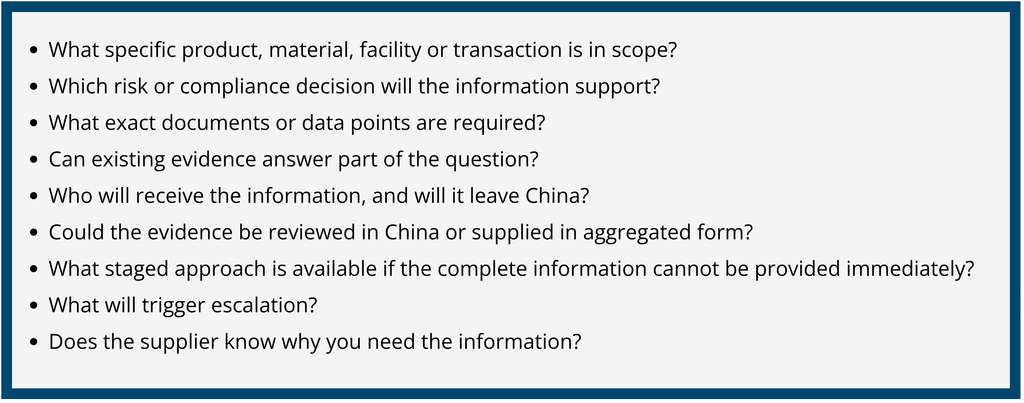
- Ask only for information you genuinely need. Complete the initial risk scoping before approaching the supplier, using information already available from purchasing records, product specifications, bills of materials, country and sector risk data, previous assessments and public sources. Then ask only for information that is necessary to test a defined risk or make a specific decision. Each request should identify the product or material in scope, the exact data points or documents required, the period covered and why the information is needed.
- Make the request specific and manageable. Provide a clear template, definitions, examples, a realistic timetable and a named contact who can answer questions. Explain who will receive the information, whether it will leave China and how it will be used and protected. Do not make perfect data a condition for starting. Agree an initial evidence set that the supplier can provide safely and improve its completeness over successive reporting cycles.
- Reuse credible evidence rather than asking for it to be recreated. Maintain one core supplier information set across procurement, legal, quality and sustainability teams. Accept relevant evidence prepared for another customer or assurance mechanism where its source, date and scope are credible. Industry schemes and technology platforms can still help organise and cross-check evidence, but the company should decide what the evidence demonstrates rather than adopting a scheme status as its conclusion.
- Separate ‘can’t’ from ‘won’t’. If a supplier cannot provide the requested information, ask what prevents disclosure, who holds the evidence and what alternative could address the underlying question. Options may include aggregated information, disclosure at regional rather than facility level, evidence reviewed on site in China, or confirmation by an appropriately qualified independent party. Persistent refusal to discuss any workable alternative is more significant than an initial gap in the evidence and may justify escalation.
- Concentrate verification where the consequences of error are greatest. Prioritise suppliers, products and facilities using indicators such as material origin, sector exposure, gaps in traceability, inconsistent production and purchasing records, previous findings and the severity of the potential impact. Cross-check supplier information against bills of materials, transaction records, production volumes, site-level evidence and credible external research. Technology can identify gaps and inconsistencies, but an accountable person within the company must decide whether the overall evidence is sufficient and what action follows.
- Build time for reassurance into the process. Targeted requests can improve supplier engagement, but they do not necessarily give immediate answers. Suppliers may need to involve legal, management, or upstream teams before they feel comfortable providing information, particularly when requests concern sensitive supply chain information or cross-border data transfers. Companies should therefore build realistic response and verification periods into procurement, investment and product-launch decisions. The key shift is recognising that getting credible reassurance may take longer than completing a standard questionnaire, especially when the evidence must withstand regulatory or investment scrutiny.
Overall, the test should not be whether every field in a due diligence process has been completed, but whether the company has enough credible evidence to understand the material risk, make a defensible decision and identify what remains uncertain.
Questions to ask before approaching a supplier in China
Why this matters beyond the immediate restrictions
Demand for supply chain evidence will continue to increase under forced labour, battery and corporate due diligence requirements. The challenge is that these requirements may depend on information held by Chinese suppliers, while those suppliers become more cautious about providing data to foreign customers. Companies should not treat this as a reason to abandon due diligence. Instead, they should identify which evidence is genuinely necessary, explain requests carefully, consider in-country or aggregated forms of verification and document the limitations of the information available.
Care is needed where the potential risk sits outside China, but the company must work through a Chinese supplier to investigate it. In these cases, the engagement should make clear that the supplier is not itself being accused of wrongdoing. The company is seeking its help to understand risks elsewhere in the upstream supply chain.
Due diligence is not only still possible; it is essential
The good news is that the August countermeasures have not made supply chain due diligence in China impossible. But they have made it harder. Companies now have to rely more on judgement, relationships and careful engagement, and less on ready-made data.
The first step is to take stock. Companies should map where they depend on the affected organisations, find out where their evidence has become out of date or has disappeared, and agree other ways to get and test the information that matters most. They should start where the risks to people are greatest.
No single replacement can rebuild what has been disrupted. The strongest programmes will combine several sources: scheme data, Chinese mechanisms judged on their merits, direct engagement with suppliers, in-country checks and the company’s own analysis. None of these is enough on its own. Together, checked against each other, they can give a assessment that holds up.
Because the limits of the countermeasures are still unclear, companies should record two things: the evidence they gather and the gaps they cannot yet fill. They should also be ready to adjust as more information comes out and market practice settles.
The current situation is reminiscent of early mapmakers, who faced a similar choice when they reached the edge of what they knew. They could fill the empty space with confident guesses, or they could mark it honestly as uncharted. The best maps were not the ones that looked complete. They were the ones that showed; which coastlines had been surveyed, which came from second-hand reports and which were still unknown. Each new voyage then filled in more of the picture.
Due diligence in China now calls for the same honesty. A company that can show what it knows, how it knows it and where its knowledge runs out is in a far stronger position than one whose map only looks complete, especially if it treats every blank space as a reason to look harder rather than a reason to stop.

