
How can mine sites use due diligence visits to prepare for mining standard certification?
Written by Fiona Hutmacher
SUMMARY: Customer due diligence site visits can help mine sites assess their readiness to comply with the requirements of mining standards (e.g. Copper Mark, CMSI, IRMA or others) before formally committing to certification. When due diligence is aligned with recognised international standards and run transparently, these assessments can serve as an early external benchmark, highlighting gaps, building team familiarity with assurance processes, and clarifying priorities. Used strategically, customer-driven due diligence site visits shift from a compliance burden to a practical preparation.
Customer requests for site visits and due diligence assessments are not always welcomed with enthusiasm at mine sites. A site assessment typically involves several days of hosting an external team, organising site tours, answering detailed questions, locating documents and stepping away from the day-to-day job of running a mine. From an operational perspective, it can feel like a distraction, or worse, an inspection designed to catch you out.
But recently, I’ve been involved in site assessments with different dynamics. In these cases, the mine sites were thinking ahead – actively preparing for certifications, but still some way off from being ready for formal assessment and certification. For them, the customer-initiated site visits turned out to be something else entirely: a valuable early benchmark of assurance readiness, at no additional cost.
Customer visits as an early certification benchmark
If a mine is in the early stages of considering certification under a standard such as IRMA, Copper Mark, CMSI or others, it may lack a clear understanding of its readiness and where to focus its efforts for successful certification. Internal self‑assessments are useful, but they rarely replicate the experience (or scrutiny) of an external assessment.
When a customer commissions a due diligence site visit, ideally supported by an experienced independent assessor, it can provide a valuable external reality check against international expectations. If approached intentionally, this can mirror a formal gap assessment under the relevant scheme and highlight strengths and priorities well ahead of the formal process (and the associated financial commitments).
The key is how the visit is framed and conducted.
How to get the most value from a customer site visit
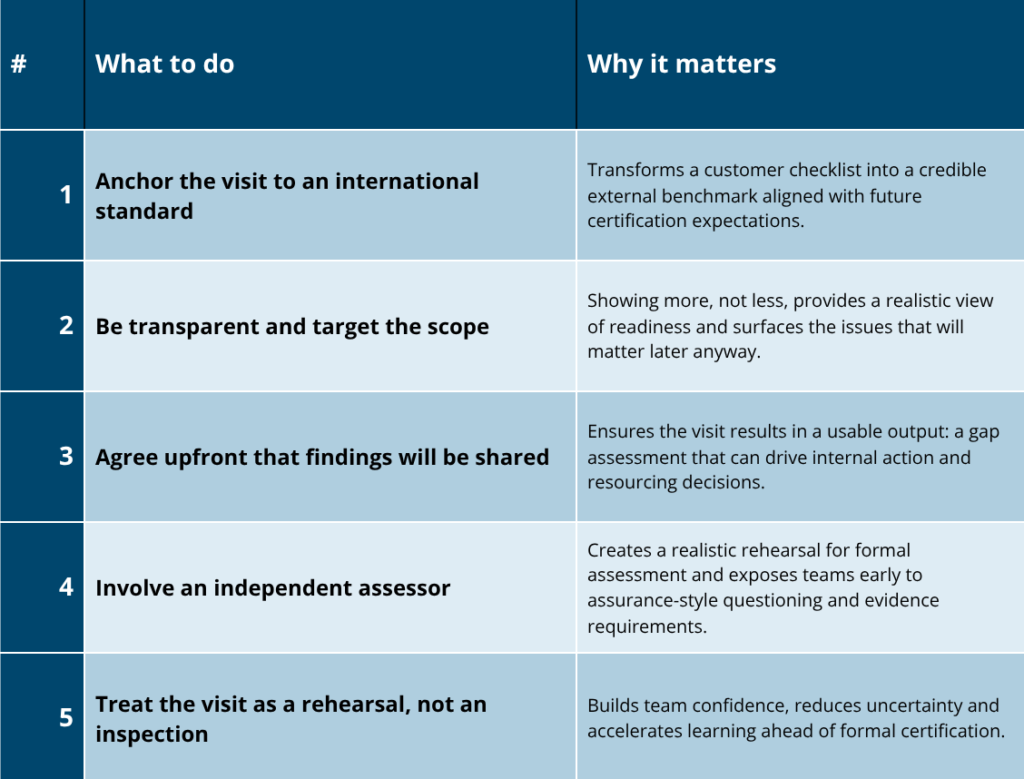
To turn a routine customer request into a meaningful readiness exercise, a few things matter:
1. Anchor the visit against a relevant international standard
If you have an interest in (one day) achieving certification against a specific mining standard, ask for the assessment to be conducted explicitly against it – or at least align with the standards’ criteria.
This shifts the visit from a customer checklist, which may not align with your operational context, to a recognised best practice benchmark. Importantly, this also means resisting the instinct to “show as little as possible.” Transparency and a targeted scope will give you far more useful insight into where you stand and what will really matter later.
There is also a strategic upside: you are signalling to your customer that you are willing to work towards, improve against, and ultimately align your practices with recognised international standards, even if you are not quite there yet. That sends a strong message about intent, maturity and direction.
2. Agree upfront that findings will be shared
Ask that the final report be shared with the site and agree that the report must include an explicit readiness or gap assessment as well as improvement recommendations.
This turns the visit into a tangible output you can use internally to prioritise actions, justify resourcing and socialise the relevant mining standard with operations, HSE, community and management teams.
3. Involve an independent expert
In many cases, customers conduct due diligence visits based on their own internal frameworks, priorities and risk perspectives. While this can provide useful insights, it may not always fully reflect the operational realities of a mine site or align with the requirements of recognised mining standards.
Bringing in an independent third party, trusted by both the customer and the site, can help bridge this gap. A neutral assessor can translate between customer expectations and site-specific context, while anchoring the discussion in widely recognised international standards rather than a single company’s approach.
This also improves the quality of the assessment itself. An independent expert can provide a more structured, consistent and comparable view of performance, helping to ensure that findings are both relevant and practically actionable.
Importantly, this approach also creates additional value beyond the immediate visit. It gives site teams early exposure to the types of questions, evidence requirements and interactions they are likely to encounter during a formal assurance assessment, turning the visit into a more realistic rehearsal rather than a one-off customer exercise.
Finally, involving the right independent expert can help build continuity. If the assessor develops a solid understanding of the site’s context and challenges, this can provide a useful foundation for future preparation work, should the site later decide to move towards formal certification.
The upside for mine sites
Handled well, customer driven site visits offer several tangible benefits:
- Strengthened engagement through alignment on objectives
By scoping a due diligence assessment against a recognised, credible assurance standard, the foundations are being laid for objective discussions of performance expectations between customer and supplier. - An external readiness assessment, effectively for free
The customer pays for the visit, but the site gains an initial benchmark that it would otherwise have to commission itself. - Team exposure to external assurance processes
Your teams experience first‑hand what an external assessment feels like, the types of questions asked, the evidence expected and the overall dynamic of an on‑site review. This is something they would need to repeat for a formal assessment in the future. Having that exposure early reduces uncertainty, builds confidence and ultimately improves performance. And, as with anything, practice makes perfect.
A mindset shift worth making
None of this is to say that every customer visit is perfectly designed or painless. But before dismissing a request as an unnecessary burden, it’s worth asking:
Could this help us assess our current position before taking the step toward formal certification?
For mine sites that are curious about external assurance standards but not yet ready to commit, customer due diligence visits can be a low-risk, high-value opportunity to learn, test assumptions and prepare more strategically.
How mine sites can turn customer due diligence visits into preparation for assurance against mining standards