
Are mining standards consolidating, or will CMSI and CCCMC add more complexity?
SUMMARY: Mining standards are consolidating in some areas but not disappearing. The Consolidated Mining Standard Initiative (CMSI) brings four major frameworks into one global standard with 24 performance areas to reduce duplication and clarify expectations. At the same time, new initiatives like China’s updated Sustainable Mining Code by the CCCMC, are emerging. Overall, core ESG requirements are converging, but multiple frameworks will likely continue to coexist, with alignment rather than full consolidation shaping the future.
Written by Fiona Hutmacher
The China Chamber of Commerce of Metals, Minerals & Chemicals Importers & Exporters (CCCMC) has recently (April 2026) launched a public consultation on its updated Sustainable Mining Code. This prompts an important question for the mining sector:
Are we genuinely moving towards fewer, more consolidated mining standards, or are new frameworks adding to an already complex landscape?
This question is particularly relevant as industry‑led consolidation efforts gather pace.
Two initiatives, one direction of travel?
The mining industry has taken a significant step towards consolidation through the Consolidated Mining Standard Initiative (CMSI), a joint effort by ICMM, The Copper Mark, the World Gold Council and the Mining Association of Canada (Towards Sustainable Mining). CMSI aims to reduce fragmentation by bringing four established standards into a single global framework.
At the same time, developments are underway on the Chinese side. CCCMC has launched its new Sustainable Mining Code, a major update to its 2014 Guidelines for Social Responsibility in Outbound Mining Investment. This reflects both evolving ESG expectations and China’s growing influence in global mineral supply chains.
These parallel developments may raise concerns about the emergence of competing frameworks, particularly between CMSI and CCCMC. However, this is not the intended direction of travel. In terms of scope and substance, both initiatives focus on broadly similar ESG issues (as outlined in the section below), and there are already promising early discussions around alignment, including the potential for joint audit approaches between the Copper Mark and CCCMC.
Looking ahead, CMSI is expected to be published in its final form towards the end of 2026, following completion of its final public consultation. For the Sustainable Mining Code meanwhile, CCCMC aims to finalise its public consultation rounds by the end of 2026.
24 core issue areas
A high‑level comparison between CMSI and CCCMC shows notable convergence between the two frameworks. Both initiatives:
- cover 24 issue areas (CMSI Performance Areas and CCCMC Sections);
- address broadly the same ESG topics, including governance, human rights, labour, community engagement, environmental stewardship and closure.
The table below illustrates this alignment and provides a high‑level benchmark between CMSI Performance Areas and CCCMC Code sections.
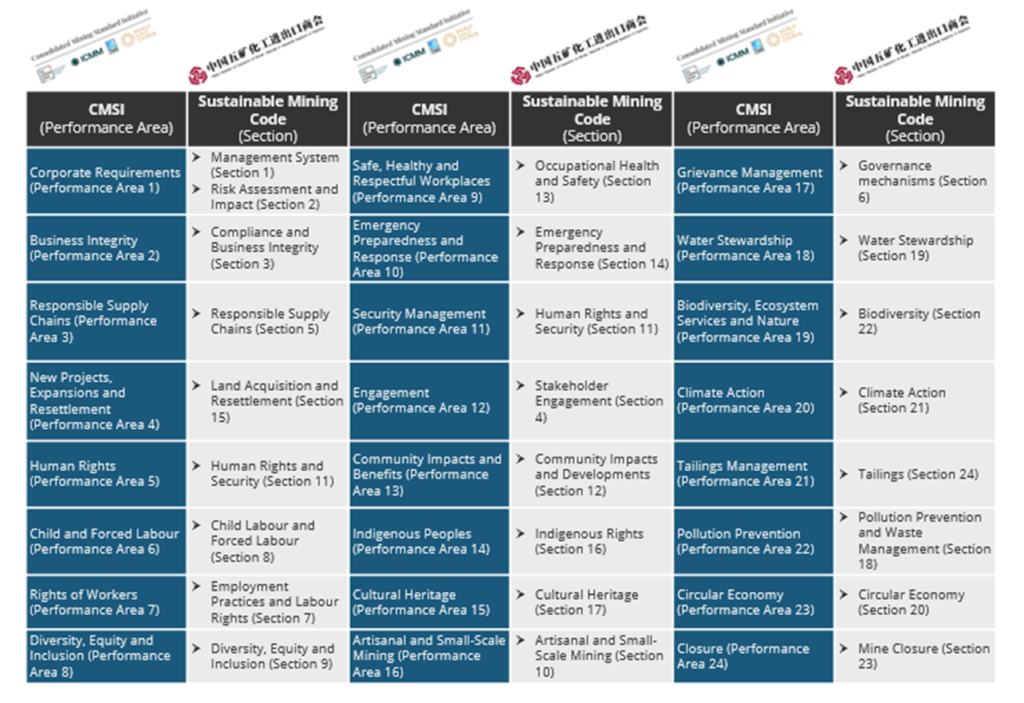
Figure 1 provides a high-level benchmark between CMSI Performance Areas and CCCMC Sustainable Mining Code requirements.
For companies considering how to prepare, this is a reassuring signal. Investments in core ESG systems are unlikely to be redundant, even if approaches and requirements might slightly differ.
Different levels, similar logic
Both standards also recognise that companies operate at different levels of maturity.
- CMSI distinguishes between Towards Good Practice, Good Practice and Leading Practice.
- CCCMC differentiates between Standard and Advanced requirements.
This tiered approach reflects operational realities and encourages continuous improvement rather than one‑size‑fits‑all compliance.
What remains unclear
Where uncertainty remains is implementation. While CMSI is being designed as an assurance‑backed standard, the CCCMC Sustainable Mining Code does not yet have a clearly defined assurance or verification mechanism. Although pilot audits, potentially involving The Copper Mark, have been discussed, how implementation will work in practice remains to be seen. Experience from existing initiatives suggests that ensure effective and consistent implementation is often the most challenging area for any industry standard. Kumi’s Alignment Assessment work highlights that even where expectations are well-defined, translating them into consistent, OECD-aligned practices remains difficult in practice. In particular, variability in audit quality and assurance effectiveness continues to be a key issue (see more here: Alignment Assessment insights for companies – Kumi)
The EU Conflict Minerals Regulation provides a useful benchmark: as of October 2025, only one scheme has achieved formal recognition by the European Commission. A consistent challenge for applying schemes has been inconsistency in the delivery of their audit programmes.
Beyond technical alignment, successful implementation will also depend on building trust and collaboration across different business cultures and political contexts. Encouragingly, early dialogue between initiatives suggests a willingness to move in this direction. Sustained cooperation, both at scheme level and between companies operating globally, will be critical to ensuring that alignment translates into practical, widely accepted outcomes.
Against this backdrop, the key question is not only whether CMSI and CCCMC align conceptually, but whether they can deliver credible, consistent and scalable assurance in practice.
What companies should focus on now
It may still be too early to assess how CMSI and the CCCMC Code will reshape assurance in practice. However, one trend is already clear: core ESG issue areas are becoming firmly established expectations.
Topics such as responsible supply chains, labour rights, community engagement, grievance mechanisms and environmental considerations (e.g. tailings management, water usage, biodiversity) feature prominently in both frameworks. Companies that have not yet systematically addressed these areas should expect growing pressure to do so.
Ultimately, whether standards consolidate further or continue to coexist, mining companies with robust governance, clear processes and credible data will be best positioned to respond.
If you would like support benchmarking your current practices against CMSI, the CCCMC Sustainable Mining Code, or both, the Kumi team would be happy to help.